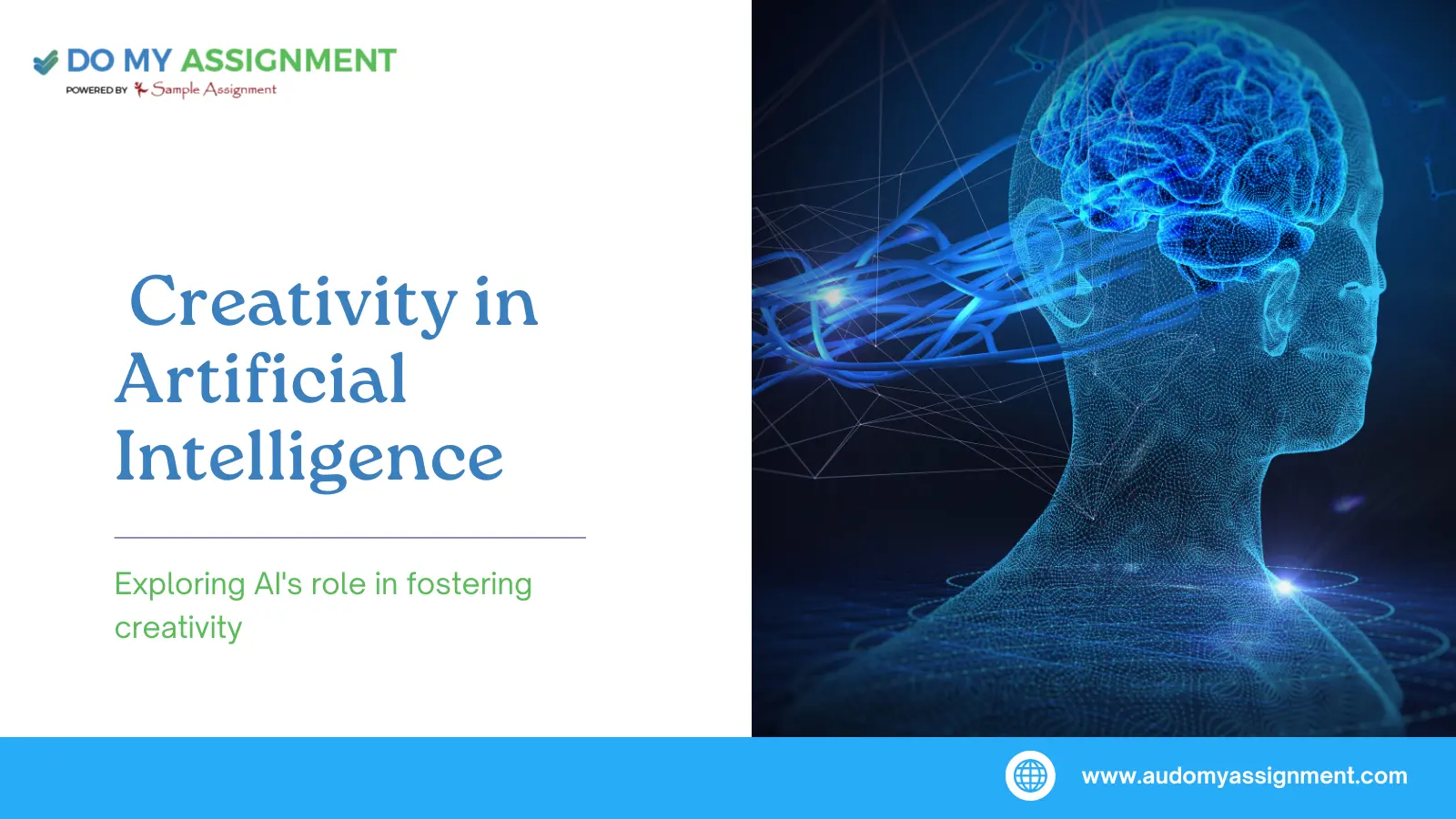
Discover Some Interesting Insights on Creativity in Artificial Intelligence
Highlights

Are you curious to learn about creativity in artificial intelligence? In this blog, you will get to learn a lot of insightful information about the same. The definition of creativity is the use of one's imagination or novel concepts, particularly in the creation of artistic works. It's debatable where such concepts originated. Does creativity originate in the heart, the brain, the soul, or one's experiences? But it's generally agreed that only humans are genuinely creative beings.
The rise of artificial intelligence (AI) and computers has resulted in systems that can imitate the work of creative writers, artists, or musicians when given enough training data, infringing on humans' exclusive right to create. Moreover, artificial intelligence techniques can be applied in several ways to generate new ideas: they can generate original combinations of well-known ideas, and they can generate new works based on the characteristics of earlier works. Besides this, they can generate new ideas based on combinations of ideas and attributes that humans might not have considered when generating a new work.
If you are pursuing your computer science engineering and opt for AI as a specialization, you will get a lot of AI assignments to complete. In case you face complexities while doing these assignments, you can get avail of free sample assignments from our team’ Our team of academic writers is highly skilled and proficient in completing a wide variety of academic tasks.
AI Technology and Creativity's Intersection
A vibrant and fascinating area exists where AI and creativity meet, enhancing human artistic endeavours through technology. Artists, writers, singers, and designers can utilize AI tools and algorithms to help them push the frontiers of creative expression, automate tedious chores, and come up with new projects. Furthermore, AI has proven to be a useful collaborator, stimulating new forms of creative inquiry and raising the bar for what the human mind is capable of. Therefore, it is used to create art, compose music, or assist in the making of content.
However, with the advent of AI, the creative scene is altering dramatically. AI systems can analyze enormous amounts of data, spot trends and patterns, and create aesthetically stunning artistic works because of advanced generative algorithms and neural networks.
Applied Artificial Intelligence
The term "applied AI" describes systems created to carry out particular tasks or find solutions to particular issues. Moreover, these systems utilize machine learning algorithms to examine data and make predictions or judgments based on that data.
Generative Artificial Intelligence
A subfield of artificial intelligence known as "generative AI" is concerned with giving robots the ability to produce unique and original information. Moreover, generative artificial intelligence (AI) uses sophisticated algorithms and neural networks to generate outputs that spontaneously resemble human creativity and decision-making. It is contrary to classic AI systems that adhere to preset rules and patterns.
Generative Artificial Intelligence is powerful because it can do more than just copy and mimic. Additionally, it can produce original and distinctive content that isn't specifically coded into the system. Therefore, it creates fascinating opportunities for a range of applications, such as virtual reality, storytelling, art, and design.
Furthermore, advanced neural networks, such as Generative Adversarial Networks (GANs) and Variational Autoencoders (VAEs), are commonly used in the construction of generative AI models.
Generative Artificial Intelligence Examples
Healthcare: Create realistic images from CT and X-ray scans to help diagnose.
Transportation and Logistics: create maps using satellite photos to enable exploration of unexplored regions.
Generative Artificial Intelligence Models
A particular architecture or implementation created to carry out generative tasks is referred to as a generative AI model. It is an artificial intelligence model that draws knowledge from preexisting data and produces new output that resembles the training data it saw. Music composition, text production, picture creation, and other domains all employ generative AI models.
Diverse generative artificial intelligence models may use different parts or variants on them. A few instances of generative AI models and their distinctive elements are as follows:
Variational Autoencoders (VAEs)
A latent space, a decoder network, and an encoder network make up a VAE. Moreover, the encoder creates a latent space representation of the input data, and fresh outputs are produced by the decoder from the latent space.
Generative Adversarial Networks (GANs)
A discriminator and a generator are the two basic parts of a GAN. While the discriminator assesses and separates the created samples from genuine ones, the generator creates new samples, such as pictures.
Transformers
In jobs involving natural language processing, transformers are frequently utilized. Moreover, they are made up of encoder and decoder layers, which allow the model to produce text sequences or do language translations.
Autoencoders
A decoder and an encoder make up an autoencoder in generative artificial intelligence. The original data is reconstructed from the latent space by the decoder after the encoder compresses the input data into a latent representation. Moreover, autoencoder variants that incorporate more elements to improve generative capabilities include variational autoencoders and eliminating autoencoders.
If it is difficult for you to write an assignment on generative AI models, don’t worry, we have got your back. We offer noteworthy assignment help to students and help them create high-quality assignments that can fetch desired academic grades. So, if you have trouble regarding your AI assignment, feel free to connect with us at ‘Do My Assignment.’
Generative Model Applications
Art, entertainment, healthcare, and other industries are just a few of the fields and industries that are greatly impacted by generative model applications. Additionally, these models may solve complicated issues, provide individualized experiences, and automate repetitive processes. Let us examine a few domains where generative AI is significantly transforming.
Art & Design
By supporting collaborative production, automating monotonous activities, facilitating the creative exploration, and aiding in idea formation, generative artificial intelligence plays a major role in art and design. By working with and learning from artists, it improves user experiences and develops artistic abilities. Moreover, generative AI in various artistic applications and technologies make real-time procedural graphics and interactive installations possible.
Creative Composition and Music
By offering automated methods for producing melodies, harmonies, and full musical compositions, generative artificial intelligence has made creative composition easier. It can let musicians experiment with arrangements, create original soundscapes, and explore new styles.
VR with Gaming
Generative AI is essential to the development of virtual worlds and engaging gaming experiences. It can provide lifelike non-player characters (NPCs), realistic surroundings, and engaging narrative components. Also, game creators can now build interactive and captivating gameplay, which improves the whole gaming experience thanks to generative AI.
Fashion & Design
Generative AI is utilized in the fashion industry to produce distinctive patterns, textures, and apparel designs. Also, it facilitates creative combination-making, maximizes fabric utilization, and allows designers to customize outfit suggestions for clients. Moreover, generative AI makes fashion more creative, efficient, and customizable.
Automation and Robotics
Generative AI plays a key role in the advancement of automation and robotics. Robots can now carry out intricate jobs, learn from and adapt to new settings, and engage with people more organically thanks to this technology. Furthermore, robots with generative artificial intelligence (AI) capabilities can improve logistics, manufacturing, and even healthcare environments.
Learning about various applications of generative AI seems quite enthralling. However, when it comes to assignment writing on such topics, it becomes quite difficult for students to deal with them. If you are also going through a similar situation, you can go through our sample assignments. Through this work, you will be able to proceed with your assignments in a seamless manner.
Future Prospects for AI and Creativity
As AI develops, we will likely witness an increasing number of instances where it's being utilized to enhance human creativity. The field of music composition is one place where this is currently taking place. Additionally, generative algorithms can analyze massive music data sets to find trends and produce brand-new compositions that resemble previously published works artistically. It's crucial to remember that humans continue to be a part of the creative process despite these circumstances. For the human composer, AI is merely a source of inspiration or a beginning point.
Design is another industry where AI is being utilized to boost creativity. Based on a variety of criteria, including colour scheme, style, and layout, generative algorithms are able to produce original designs. In the end, it is up to the human designer to determine which design best suits the requirements of the project, even though this can save them time and give them fresh inspiration.
Conclusion
In summary, artificial intelligence will not quickly surpass human creativity. AI lacks the emotional intelligence, life experiences, and consciousness required to fully mimic the creative process of humans, despite the fact that it is capable of carrying out some creative activities. However, AI can be utilized to support and augment human creativity, giving creatives a fresh perspective and source of inspiration. It will be interesting to see how AI is applied to push the limits of human creativity even more as it develops.
However, if you can’t encounter the issues that come up with AI assignments, you can always rely on our skilled writers at ‘Do My Assignment.’ We ensure you the best experience regarding academic writing assignment help.
If you're a student exploring AI and need help understanding machine learning concepts, check out our Machine Learning Assignment Help Online service.



Nick Johnson
Nick is a multi-faceted individual with diverse interests. I love teaching young students through coaching or writing who always gathered praise for a sharp calculative mind. I own a positive outlook towards life and also give motivational speeches for young kids and college students.
Get Free Quote In 2 Minutes*

Related Blog


Still Confused? Take a look at the reviews of DoMyAssignment
6984+ Positive Reviews with a rating of 4.9/5

21-04-2023
Biotechnology
Incredible service! My assignment was perfect and delivered on time. Highly recommend Do My Assignment!Connor, Order Code: SA**398

18-04-2023
Management
Excellent support and high-quality work! Saved me so much time and stress. Thank you!Peter, Order Code: SA**358
12-04-2023
Nursing
Fantastic experience! Quick delivery and top-notch quality. Will definitely use Do My Assignment again!James, Order Code: SA**698
05-04-2023
Accounting
Reliable and professional! The assignment met all my requirements. Great service!Jordie, Order Code: SA**613
21-04-2023
Mathematics
Outstanding work! The team was very responsive and the assignment was flawless. Highly recommended!Harper, Order Code: SA**112
28-03-2023
Management
Do My Assignment exceeded my expectations! Detailed, well-structured, and prompt delivery.Tom, Order Code: SA**558
21-03-2023
Engineering
Highly satisfied! My assignment was well-researched and excellently written. Great job!Chris, Order Code: SA**287
15-03-2023
Physics
Amazing service! The quality exceeded my expectations. Delivered before the deadline!Sheryl, Order Code: SA**412
10-03-2023
Programming
Superb assistance! Professional, punctual, and perfect. Do My Assignment is the best!Ben, Order Code: SA**271
18-04-2023
Statistics
Exceptional work! The assignment was detailed and well-organized. Truly impressed!Sydney, Order Code: SA**388
09-03-2023
Company Law
Top-quality service! My assignment was accurate and well-written. Will use again!Tory, Order Code: SA**943
04-03-2023
Xero
Professional and efficient! Delivered high-quality work right on time. Very pleased!Henry, Order Code: SA**732
23-02-2023
Economics
Fantastic support and excellent writing! Made my academic life so much easier!Cameron, Order Code: SA**906
19-02-2023
Dissertation
Great experience! Thorough research and perfect formatting. Highly recommend!Phil, Order Code: SA**322
15-02-2023
Chemical Engineering
Excellent quality and timely delivery! Very happy with the service provided.Jon, Order Code: SA**625
11-02-2023
SPSS
Perfectly done assignment! Clear, concise, and delivered on schedule. Thank you!Mitchell, Order Code: SA**590
08-02-2023
Company Law
Super fast and reliable! The assignment was spot on. Definitely worth it!Monica, Order Code: SA**821
05-02-2023
IT
Amazing job! The content was insightful and precisely what I needed. Bravo!Jaspreet, Order Code: SA**432
01-02-2023
Management
High-quality work and timely submission! Very professional service. Will order again!Ankita, Order Code: SA**834
24-01-2023
Taxation
Exceptional writing and great customer service! Truly a life saver for students!Alex, Order Code: SA**228